


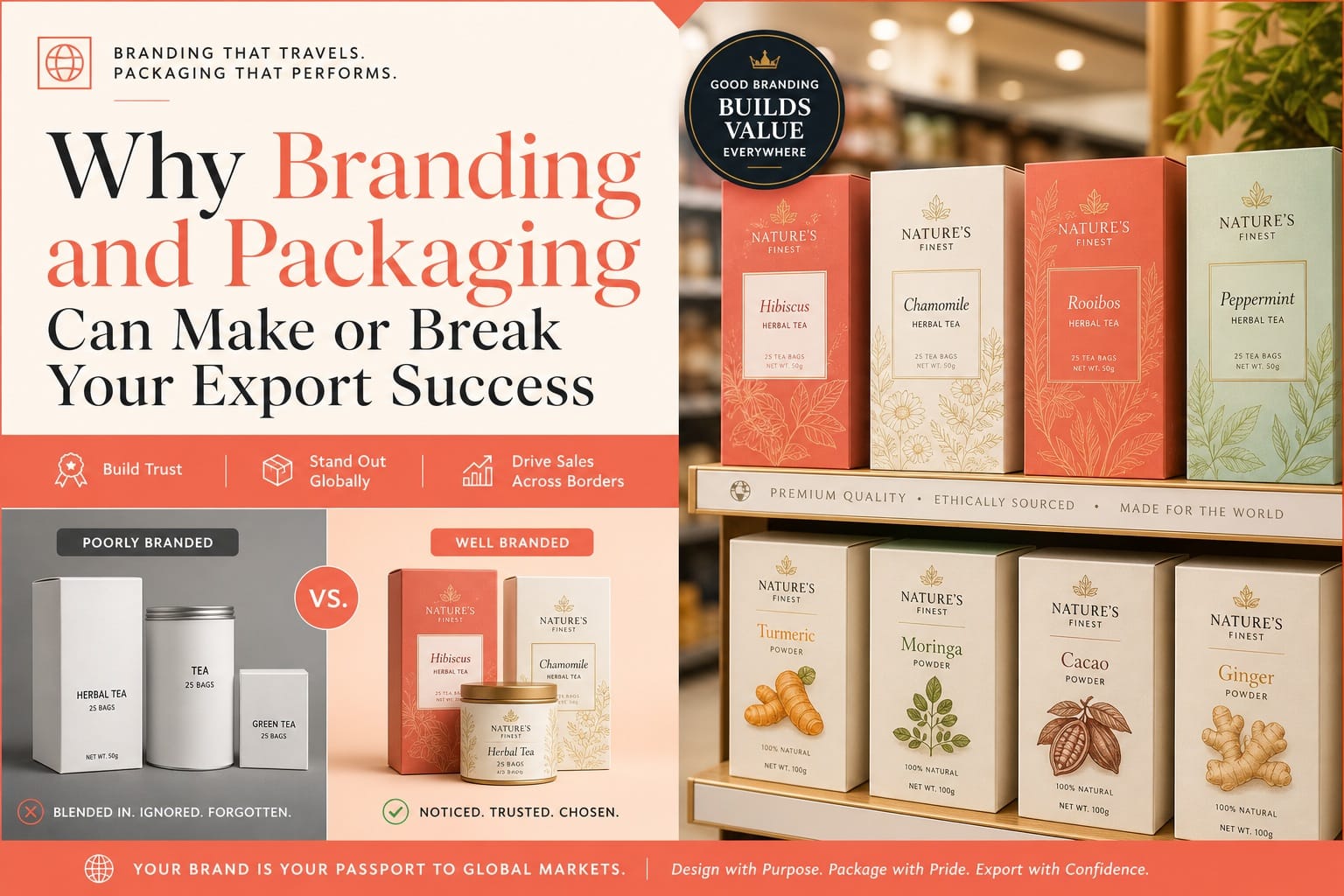
You have a great product. You have done your market research. You have identified your target market and found potential buyers. But when your product arrives on the shelf of a foreign retailer — or in the inbox of an international buyer — the first thing they see is not your product. It is your packaging and branding.
In international trade, packaging and branding are not just aesthetic decisions. They are strategic weapons — and getting them wrong can cost you the market before you have even had a chance to compete.
Branding is More Than a Logo
Many SMEs think branding is about designing a nice logo and choosing a colour scheme. But in international markets, your brand must do much more:
- Your brand must communicate your Unique Selling Proposition instantly. International buyers and consumers make decisions in seconds. Your brand name, tagline, and visual identity must immediately convey what makes you different and why they should choose you.
- Your brand story must be compelling and culturally relevant. A story that resonates deeply in your home market may mean nothing — or worse, cause offence — in another culture. Your brand narrative must be adapted for your target audience.
- Your brand must be consistent across every touchpoint — packaging, website, social media, trade fair materials, and product catalogues. Inconsistency destroys trust with international buyers.
The Hidden Science of Export Packaging
Export packaging is a specialised discipline that goes far beyond design. Here is what most businesses do not know until it is too late:
Colour Psychology Varies Dramatically by Country
Colour is one of the most powerful and most misunderstood elements of international packaging. What works in one market can actively hurt you in another:
- White is associated with purity and cleanliness in Western markets, but symbolises mourning and death in many East Asian cultures including China, Japan, and Korea.
- Green signals health and nature in Europe and North America, but can have religious connotations in some Middle Eastern markets that may not align with your brand.
- Red communicates urgency or danger in some markets, while representing luck, prosperity, and celebration in Chinese culture — making it highly effective for premium products in that market.
- Purple has historically been associated with royalty and premium positioning in Western markets, but may carry different associations in Latin American countries.
Smart exporters work with packaging specialists who understand the cultural dimensions of colour in their specific target markets — not just generic design principles.
Labelling Compliance is Non-Negotiable
Every country has strict and specific rules about what must appear on your product label — and how it must appear. Non-compliance can result in shipment rejection, product recalls, significant financial penalties, and permanent damage to your buyer relationships.
Key labelling requirements that vary by market include:
- Language requirements — many countries mandate labelling in the local language, with specific regulations about font size, prominence, and translation accuracy.
- Nutritional and ingredient declarations — formats, measurement units, and mandatory information differ significantly between the EU, USA, GCC countries, and Asian markets.
- Allergen disclosures — requirements for highlighting allergens vary in format and scope across different regulatory systems.
- Country of origin statements — rules about how and where this appears differ by market and product category.
- Certification and quality mark displays — organic, fair trade, halal, kosher, and other certifications have specific rules about how they may be displayed on packaging.
- Barcode standards — GS1 barcodes must be correctly formatted and registered for your target market’s retail systems.
Container Optimisation: The Cost You Cannot Ignore
One of the most overlooked aspects of export packaging is container optimisation — how efficiently your product fills a shipping container. This is not just a logistics consideration; it is a fundamental driver of your export competitiveness.
Poor packaging design that wastes container space increases your landed cost per unit, which directly reduces your price competitiveness in the target market. A product that could have filled a 40-foot container efficiently but only fills 60% of it due to packaging inefficiency is carrying a significant and entirely avoidable cost penalty.
Smart packaging design considers unit dimensions, stacking strength, palletisation efficiency, and container fill rate from the very beginning of the design process.
Your Packaging is Your Salesperson
In markets where you do not have a physical presence, your packaging is doing the selling for you. It must communicate your USPs clearly, build trust instantly, tell your brand story compellingly, meet all regulatory requirements, and stand out against established competitors — all at the same time.
| At VOLTEGRO Global, branding and packaging strategy is a core component of our Export Readiness Services. We bring together brand strategy, cultural intelligence, regulatory compliance expertise, and packaging engineering to ensure your product is truly ready for its target market. |
Real Results from Smart Branding
In our Export Accelerator Programmes, we have worked with businesses creating compelling brands from the ground up — from wellness teas and natural cosmetics to artisan foods and sustainable home goods. The businesses that invest seriously in their international branding and packaging consistently outperform those who treat it as an afterthought.
Because in international trade, you rarely get a second chance to make a first impression.
| Is your packaging and branding truly ready for international markets? Let VOLTEGRO Global assess and transform your brand for global success. Contact us today. |
Leave a Reply